Products & Transfer
Publications
Scientific articles and books
-
- 2026
-
Awoke, M.D. and Brück, T. (2026).Climate, conflict, and food security: a systematic review of household-level evidence (2020–2025).Journal of Health, Population and Nutrition, 45(1), p. 70.
- Behrend, D., Srivastava, A.K. et al. (2026).
Breeding changes water use of winter wheat across Europe.
npj Sustainable Agriculture. Article accepted and in press. - Fischer, H., Boschert, E., Böhnisch, A.N.A., Abele, L. & Huff, M. (2026).
Communicating complex climate dynamics with the En-ROADS simulator: Comparing graph-based and animated environments for learning, metacognition, and motivation.
Submitted: review pending. - Göbel, J. P., Buder, J., Ogiermann, M., Burkhardt, M., Forstner, A., Fischer, H., & Huff, M. (2026).
Understanding the gateway: Unpacking the mechanisms, boundaries, and outcomes of climate consensus messaging.
Journal of Environmental Psychology, 110, 102913.
https://doi.org/10.1016/j.jenvp.2026.102913 - 2025
- Alsafadi, K., Sun, J., Ullah, I. et al. (2025).
Urbanization's dual role in the exacerbation and mitigation of drought dynamics in China.
npj Urban Sustainability, 5, 79.
https://doi.org/10.1038/s42949-025-00267-z - Awoke, M. D. & Brück, T. (2025).
Climate, conflict, and food security: A systematic review of household-level evidence (2020–2025).
HiCN Working Paper Series, 2025(445).
https://hicn.org/working-paper/445/ - Böhnisch, A., Huff, M., Treml, C. & Wittenborg, T. (2025).
Inventory on Science Communication on the Thematic Area of Climate Change.
https://doi.org/10.48366/R1562245 - Eshetu, S. B., Löhr, K., Awoke, M. D., Lana, M., & Sieber, S. (2025).
Guiding sustainable land use planning in Ethiopia: A decision support framework using analytic hierarchy process.
Trees, Forests and People, 101106.
https://doi.org/10.1016/j.tfp.2025.101106 - Fischer, H., & Huff, M. (2025).
Metacognition as a target of science communication.
Nature Reviews Psychology, 4(9), 554–555.
https://doi.org/10.1038/s44159-025-00478-2 - Gerten, D., Almeida, B., Lade, S. J. & Norberg, A. (2025).
Join the dots on planetary boundary interactions.
EGUsphere [preprint].
https://egusphere.copernicus.org/preprints/2025/egusphere-2025-4761/ - Ghaemi, H., Snyder, L., & Stocker, M. (2025).
Advancing Scientific Knowledge Retrieval and Reuse with a Novel Digital Library for Machine-Readable Knowledge. In Proceedings of the 48th International ACM SIGIR Conference on Research and Development in Information Retrieval (pp. 4010–4014).
SIGIR '25: The 48th International ACM SIGIR Conference on Research and Development in Information Retrieval. ACM.
https://doi.org/10.1145/3726302.3730134 - Hakim, A., Srivastava, A.K., Hamza, A. et al. (2025).
Yolo-pest: an optimized YoloV8x for detection of small insect pests using smart traps.
Scientific Reports, 15, 14029.
https://doi.org/10.1038/s41598-025-97825-3 - Halder, K., Ewert, F., Ghosh, A. et al. (2025).
High-resolution maize yield mapping across Africa using earth observation and machine learning, deep learning, and foundation model.
Science of Remote Sensing, 13, 100344.
https://doi.org/10.1016/j.srs.2025.100344 - Halder, K., Srivastava, A.K., Zheng, W. et al. (2025).
A robust and scalable crop mapping framework using advanced machine learning and optical and SAR imageries.
Smart Agricultural Technology, 12, 101354.
https://doi.org/10.1016/j.atech.2025.101354 - Hoffmann, M., Chen, C., Butterbach-Bahl, K., Ewert, F., Holz, M., Kiese, R., Augustin, J., Dubbert, M. (2025).
Advancing sustainable agricultural transformation through the synergy of automated experimental platforms and living labs.
Nature Communications, 16, 8418.
https://doi.org/10.1038/s41467-025-64450-7 - Ruml, A., Chen, C., Kubitza, C., Kernecker, M., Grossart, H.-P., Hoffmann, M., Holz, M., Wessjohann, L.A., Lotze-Campen, H., Dubbert, M. (2025).
Minimizing trade-offs and maximizing synergies for a just bioeconomy transition.
Energy Research & Social Science, 125, 104089.
https://doi.org/10.1016/j.erss.2025.104089 - Stocker, M., Snyder, L., Anfuso, M., Ludwig, O., Thießen, F., Farfar, K.E., Haris, M., Oelen, A., Jaradeh, M.Y. (2025).
Rethinking the production and publication of machine-readable expressions of research findings.
Scientific Data, 12, 677.
https://doi.org/10.1038/s41597-025-04905-0 - Warner, B., Piorr, A., Grossart, H.-P., Müller-Petke, M., Schanze, J., Schiller, G. (2025).
Urban-rural interdependencies from an Earth system's view – Principles and perspectives leading to new integrative and transformative research.
Environmental Science & Policy, 171, 104165.
https://doi.org/10.1016/j.envsci.2025.104165 - Wenda, B. D. S., Njoya, H. M., Awoke, M. D., Kimaro, P. E., Sieber, S. & Löhr, K. (2025).
Integrated Soil Fertility Management for Sustainable Food Security: Evidence From Cameroon.
Food and Energy Security, 14(5), e70145.
https://onlinelibrary.wiley.com/doi/10.1002/fes3.70145
Videos
Leibniz Lab 'Systemic Sustainability' at a Glance
Agriculture and food production are responsible for around 30 per cent of global animal and plant species loss and contribute more than 20 per cent of greenhouse gas emissions. Resulting climate change and biodiversity loss are increasingly jeopardising agriculture and food security for a growing world population. This raises doubts about our ability to achieve several Sustainable Development Goals and to remain within the limits of the Earth system, the so-called Planetary Boundaries.
The Leibniz Lab ‘Systemic Sustainability’ responds to these tasks by treating biodiversity, climate, agriculture and food as a common area of action and conflict. It pursues three main goals:
• integrating knowledge from scientific communities and societal groups,
• assessing systemic sustainability and exploring systemic innovations,
• and advancing science communication through transfer products tailored to target groups.
As a knowledge hub, the Lab is drawing on collaboration with national and international partners and working closely with societal actors. Dialogue forums at international, national and regional level support the exploration of the added value of the systemic sustainability perspective.
Contact: Prof. Dr. Jochen Schanze (ll-systain@ioer.de)
You are currently viewing a placeholder content from YouTube. To access the actual content, click the button below. Please note that doing so will share data with third-party providers.
From Invasion to Innovation: Turning Lionfish into a Resource for Sustainable Food Systems in the Pilot Site ‘Belém’, Brazil
The Leibniz Lab ‘Systemic Sustainability’ examines the role of innovations in enabling sustainability transformations. A focus lies on identifying locally grounded solutions that emerge directly from socio-ecological challenges in the globally distributed pilot sites.
In the pilot site ‘Belém’, Brazil, especially in Pará, activities build on preceding transdisciplinary research conducted at the Leibniz Centre for Tropical Marine Research (ZMT) by Dr. Marion Glaser together with Lena Knopp. Within their work, local realities and sustainability challenges were explored through an arts-based approach using stop-motion filmmaking in collaboration with local community actors. Through this process, the increasing invasion of lionfish (Pterois spp.) emerged as a major locally perceived concern. Fishers described how the venomous invasive species clogs nets and poses handling risks, while simultaneously affecting local marine ecosystems, thus reducing stocks and catches of local species.
Internationally, initial initiatives (e.g., for the Mediterranean and Caribbean) have explored the harvesting and consumption of invasive lionfish as a strategy to reduce ecological impacts while creating economic value. Promoting lionfish as a new food resource can provide incentives for its removal from marine ecosystems and contribute to diversified seafood options in already heavily exploited oceans.
Building on these insights, Lena Knopp and Dr. Marion Glaser teamed up with regional partners from the Federal University of Pará (UFPA). Together, they conducted workshops with local food system actors such as chefs and food practitioners to explore the culinary use of lionfish within regional food cultures. Following an “eat the invader” approach, the workshops addressed invasive species not only as an ecological challenge but also as a potential resource for sustainable food systems. As an outcome of these activities, cooking videos were produced in Portuguese and English, demonstrating how the lionfish can be safely prepared in two locally inspired recipes. The videos aim to increase awareness and consumer acceptance while illustrating how environmental challenges can be translated into sustainability-enhancing food system innovations.
The initiative highlights how sustainability transformations can emerge from transdisciplinary collaboration and local knowledge, linking biodiversity management and sustainable food systems in coastal regions facing rapid environmental change.
Contact: Sarah Zwicker (sarah.zwicker@leibniz-zmt.de) & Sophia Lüttringhaus (sluettringhaus@atb-potsdam.de)
You are currently viewing a placeholder content from YouTube. To access the actual content, click the button below. Please note that doing so will share data with third-party providers.
You are currently viewing a placeholder content from YouTube. To access the actual content, click the button below. Please note that doing so will share data with third-party providers.
Online Magazine
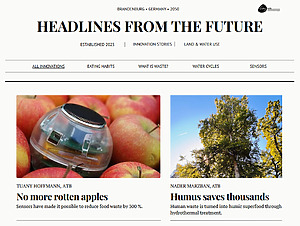
Innovations for Sustainable Food Systems from Berlin/Brandenburg: Headlines from the Future
With the aim of bringing together innovators from the pilot site ‘Berlin/Brandenburg’ of the Leibniz Lab ‘Systemic Sustainability’, a series of online and in-person workshops were organised in September 2025. The workshops created a space for innovators from research and practice to exchange perspectives on how their work contributes to food systems operating within planetary boundaries. The events were facilitated by Glashaus Innovation, a Berlin-based, human-centered innovation design consultancy.
The exchange formed the basis for the creation of the digital gallery Headlines from the Future. In short video and photo portraits, innovators present their work as messages from the future and illustrate how diverse innovation approaches emerging across the pilot site ‘Berlin/Brandenburg’ could contribute to transformed food systems by 2050. At a time when sustainability transformations are often associated with restrictions and renunciations, the Headlines from the Future deliberately highlight a positive and enabling vision of change. By presenting a future in which innovations have already succeeded, the gallery shifts attention to the opportunities created through transformations. The gallery illustrates how sustainable food systems can be societally desirable.